 +971 4 584 1014
 +971 58 684 1014
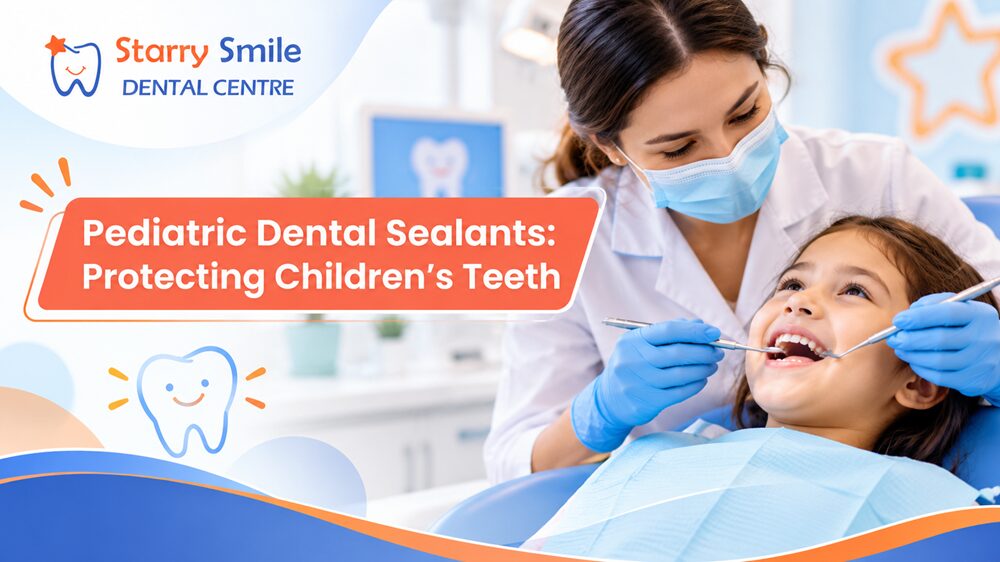
Children love snacks, chocolates, juices and plenty of foods that can leave particles behind on their teeth. Although regular brushing helps remove much of this debris, toothbrush bristles cannot always reach the tiny grooves found on the chewing surfaces of back teeth. As a result, these areas can become vulnerable to cavities.
Fortunately, pediatric dental sealants offer a simple preventive solution. A dentist places a thin protective layer over the deep pits and grooves of the molars, creating a smoother surface that is easier to keep clean.
For families in Dubai, preventive dental care can make a major difference during a child’s growing years. At Starry Smile Dental Clinic – Dubai, parents can discuss whether dental sealants for children are suitable based on their child’s tooth development, oral hygiene habits and individual cavity risk.
A dental sealant is a thin coating placed mainly on the chewing surface of a child’s back teeth. Molars naturally contain pits and fissures where plaque and food can collect.
Instead of allowing bacteria to settle inside these narrow spaces, the sealant forms a physical protective barrier.
According to the American Dental Association, pit-and-fissure sealants can help prevent cavities in both primary and permanent molars. They may also help stop certain early, non-cavitated lesions from progressing.
Therefore, sealants work as part of preventive dentistry rather than as a substitute for brushing, flossing or regular dental check-ups. Get details on Dental Clinic in Dubai.
The chewing surfaces of molars are not completely flat. Instead, they have narrow valleys, grooves and tiny depressions.
Food particles may settle inside these areas even when children brush every day. Moreover, young children are still developing proper brushing techniques. Consequently, plaque may remain around difficult-to-clean surfaces.
Sealants cover these vulnerable grooves and make the surface less favourable for food and bacteria accumulation.
The CDC reports that children aged 6–11 without sealants are almost three times more likely to develop cavities in their molars compared with children who have sealants.
Timing plays an important role.
Generally, dentists recommend checking a child’s permanent molars soon after they erupt. The first permanent molars usually appear at around 6 years of age, while second permanent molars commonly erupt at around 12 years.
However, age alone does not determine whether sealants are required. For example, a child with deep tooth grooves, previous cavities or difficulty maintaining oral hygiene may benefit more strongly.
In some cases, dentists may also recommend sealants for baby teeth, particularly when the primary molars have deep grooves and a higher risk of decay.
|
Approximate Stage |
Teeth to Monitor |
Why Sealants May Help |
|
2–5 years |
Selected baby molars |
May protect deep grooves in high-risk children |
|
Around 6 years |
First permanent molars |
Newly erupted molars can be vulnerable to decay |
|
7–11 years |
Existing permanent molars |
Dentist can monitor sealant condition and cavity risk |
|
Around 12 years |
Second permanent molars |
Newly erupted second molars may benefit from protection |
|
Teen years |
Permanent back teeth |
Sealants can be reviewed, repaired or replaced if required |
Sealants have a strong role in preventing childhood tooth decay.
CDC information indicates that sealants can prevent approximately 80% of cavities for two years in the back teeth and continue protecting against about 50% of cavities for up to four years.
In addition, ADA evidence supports using sealants on sound permanent molars as well as certain non-cavitated early lesions in children and adolescents.
Still, results depend on several factors, including sealant retention, tooth condition, eating habits and overall oral hygiene. Therefore, dentists normally inspect sealed teeth during routine check-ups. Looking for a Invisalign Treatment in Dubai.
Parents sometimes assume sealants and fluoride perform exactly the same job. However, they protect teeth in different ways.
|
Dental Sealants |
Fluoride Treatment |
|
Creates a physical barrier |
Helps strengthen tooth enamel |
|
Mainly protects pits and grooves |
Offers broader enamel protection |
|
Commonly used on molars |
Can benefit many tooth surfaces |
|
Particularly useful for deep fissures |
Useful for managing overall cavity risk |
|
Can remain for several years |
Usually repeated according to dental advice |
In fact, these treatments can complement each other. A child may receive fluoride treatment and dental sealants as part of an overall preventive dental plan.
Parents are often pleased to learn that dental sealant application is usually quick and does not involve drilling.
First, the dentist examines and cleans the tooth. Next, the tooth surface is prepared so the sealant can bond properly. The area is then kept dry.
After that, the dentist paints the sealant material into the grooves of the tooth. Depending on the material, a special curing light may be used to harden it.
Finally, the dentist checks the child’s bite and ensures that the coating sits correctly.
Because the procedure is conservative and straightforward, most children manage it comfortably. Get details on Root Canal Treatment in Dubai.
No drilling is usually needed when sealants are being placed on healthy pits and fissures. Therefore, the procedure is generally painless.
Children may notice someone cleaning, drying and working on the tooth, but they normally should not experience the discomfort associated with treating a deep cavity.
This is one reason why preventive appointments can help children build more positive feelings about visiting a dentist.
Sealants can provide protection for several years, although they are not permanent.
Chewing, grinding and normal wear can gradually affect the coating. For that reason, dentists inspect the sealants during regular visits.
If part of a sealant becomes worn or damaged, the dentist may repair or reapply it.
Interestingly, the CDC notes that dental sealants can continue providing meaningful cavity protection several years after placement.
Related Services:
» Root Canal Treatment for Children in Dubai
» Orthodontic Treatment in Dubai
» Teeth Whitening Treatment in Dubai
Dental sealants have been widely used in preventive dental care.
Parents sometimes ask about materials such as BPA. The ADA states that potential BPA exposure associated with dental sealants is extremely small and that evidence has not demonstrated adverse effects caused by BPA exposure from sealants.
Nevertheless, parents should always discuss allergies, medical history and any specific concerns with their child’s dentist before treatment.
Although many children can benefit, sealants may be particularly useful for children who:
However, dentists assess every child separately. A sealant may not be suitable if a tooth already has significant decay or requires another form of treatment.
Sealants provide useful extra protection, but they do not make teeth cavity-proof.
Children should still brush twice daily with age-appropriate fluoride toothpaste, clean between teeth when advised and limit frequent sugary snacks and drinks. In addition, regular dental examinations allow the dentist to identify small problems before they develop further.
Therefore, think of sealants as an extra shield rather than a replacement for good oral hygiene.
Related Articles:
» Why Early Orthodontic Care Matters for Children’s Smiles?
» Tips to Reduce Dental Anxiety in Children
» Gum Diseases in Children: Signs, Prevention and Care
» Teeth Whitening Care: Essential Tips for a Brighter, Healthier Smile
» Essential Dental Treatments for Children Every Parent Should Know
Dubai families often have busy routines involving school, extracurricular activities and travel. Consequently, prevention can be easier than dealing with unexpected toothache or extensive dental treatment later.
At Starry Smile Dental Clinic – Dubai, a dentist can examine your child’s molars, assess their cavity risk and explain whether pediatric dental sealants in Dubai could provide useful additional protection.
Early preventive care may help preserve healthy natural teeth while encouraging children to develop better dental habits for the future.
Dental sealants. These are thin protective coatings. Applied to the grooves of back teeth. They will create a barrier. Between vulnerable tooth surfaces. Also cavity-causing food particles and bacteria.
Children are commonly assessed. Around age six. When the first permanent molars erupt. Also again around age twelve. When the second permanent molars appear.
Yes. In selected children. With deep grooves. Or a higher cavity risk. A dentist will recommend sealants. For primary molars.
Usually not. Sealant placement. This will normally require no drilling. Or injection. When applied to suitable healthy or assessed tooth surfaces.
The actual application is generally quite quick. However, appointment length varies depending on how many teeth require treatment and how comfortable the child is.
Children can eat and drink normally. After sealant application. Once the material has properly set.
Yes. Sealants will mainly protect. The chewing grooves they cover. Cavities will still develop between teeth. Or on other surfaces. Especially when oral hygiene is poor.
No. Sealants and fluoride will work differently. A dentist may recommend both depending on a child’s cavity risk.
Sealants can wear down. Chip. Or become partially lost over time. So dentists check them. During routine dental examinations. Also reapply them. When needed.
CDC data. This indicates that sealants can prevent 80% of cavities. For two years in back teeth. Also continue providing considerable protection. Beyond that period.
Not necessarily. Dentists will consider tooth anatomy. Cavity history. Hygiene habits. Diet. Also overall decay risk. Before recommending treatment.
Parents can arrange a pediatric dental assessment at Starry Smile Dental Clinic – Dubai to discuss tooth development, cavity risk and whether dental sealants are appropriate for their child.
Comments are closed.


Pediatric Tooth Extraction: When Is It Necessary?
[…] » Pediatric Dental Sealants: Protecting Children’s Teeth […]